Agent Directory
The problem
Building AI agents on Google's Agent Development Kit (ADK) is one thing. Making them discoverable, standardized, and usable by other developers is a different problem entirely. The ADK ecosystem had no central place to find, share, or contribute production-ready agents — every team was rebuilding similar capabilities in isolation.
The system
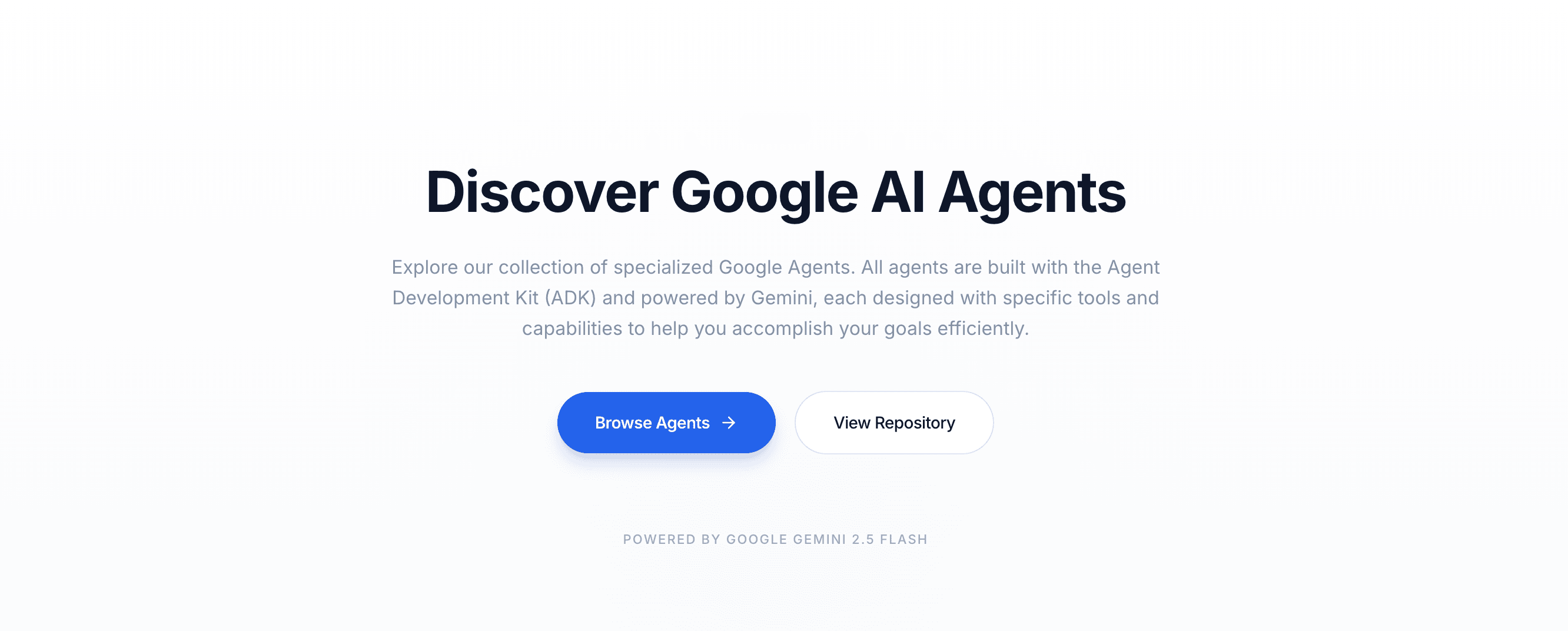
Agent Directory is an open-source, community-driven platform where developers browse AI agents by category, tags, and capabilities. Each listed agent ships with structured metadata, sample prompts, use cases, and documentation. Contribution happens through a simple metadata.json schema and a pull request workflow — low friction for contributors, consistent enough that discovery actually works.
The platform itself runs on the stack it showcases: Google ADK orchestrating the backend logic, Gemini 2.5 Flash for reasoning, FastAPI serving the directory API, Next.js 16 on the frontend, and Neon Postgres for agent metadata and user data. Building the directory on ADK was deliberate — proof that the platform handles production workloads, not just demo scripts.
The outcome
- Featured in Google's official ADK community documentation as a reference resource for agent discovery
- Open-source contribution workflow with standardized metadata across all listed agents
- Self-demonstrating: the directory is the largest public ADK deployment of its kind, and its architecture is itself a reference implementation for other builders
What I took from it
Autonomous systems only create real value when they're discoverable and composable. The hard part of agent development is rarely the model call — it's schema design, contribution flow, and making the system legible enough that others can build on it. Most agentic projects skip that layer. Skipping it is why most agents stay internal and invisible.